Wednesday, April 18, 2012

Journey + Adventure = Growth


Truth is...Fuad & I want to start a family so we decided to take a trip that would tide us over until we're ready to travel with kids in tow... In preparing for my April break we compiled a list of dream places and we really took our time before narrowing it down...Cambodia & Sri Lanka won. It doesn't seem practical, does it, to travel to not one, but two countries in different directions from our home in a 2 week time span? We wanted this to be BIG since we may not be taking another trip for awhile (besides our trip home to the States this summer) and one of the reasons we decided to move over here was so we could explore this part of the world.
Once we decided on the locations, Fuad did all of the work. He did the research and found us the coolest places to stay, he booked all the flights, he arranged all of the rides, he pre-ordered our visas. All I had to do was spend a few hours at the Thai Immigration office getting my multi-entry visa and then show up. I'm one lucky lady!

Perhaps some more detail will put this trip in perspective. Here is our insane itinerary:

Flight-Chiang Mai to Bangkok (1 hour)
2 days in Bangkok (hotel) I sightsee, Fuad works
Flight-Bangkok to Siem Reap (45 minutes-FREE for both of us by using air miles)
3 nights hotel, MASSIVE sightseeing around Angkor Wat
Drive (5 hours) from Siem Reap to Phnom Penh (I now know more about Mr. Ly, our driver than I do about people in Thailand I've been working with everyday for 9 months!)
Flight-Phnom Penh to Bangkok (1 hour)
1 night airport hotel (wake up call 3:30 am!)
Flight-Bangkok to Colombo (3 hours) (A promo deal from AirAsia for $35 per person!)
1 night hotel Colombo (FREE from Hilton points-Fuad spends a morning at Leo Burnett Colombo)
Drive (5 hours) from Colombo to Dambulla
2 nights stay at the Heritance Kandalama (1 day relaxing, 1 day spent MASSIVE sightseeing)
Drive (5 hours) to Kosgoda
3 night stay at Saffron and Blue the amazing beach home of Ranil de Silva, Fuad's friend & colleague from Leo Burnett Colombo...which is where I currently type this...lounging on the daybed, with an amazing view of a storm getting ready to roll in, and the beach a stones throw away.  There's a breeze, and the constant sound of the waves crashing...I know I have found paradise and after the last 2 weeks of adventure, I'm ok with simply laying here and enjoying the view.
Tomorrow we will be sightseeing, taking a day trip to Galle, and then we start the return trip home.
Sunday morning early rise...
Drive (2 hours) to Colombo
Flight-Colombo to Bangkok (3 hours)
Flight Bangkok to Chiang Mai (1 hour)
Taxi to pick up Baxter... and then...home.

We have seen the ancient temple ruins of lost Angkor empires in Cambodia, which are impossible to put into words. We honored the souls lost in a genocide that seems greatly overlooked by the world. We climbed a giant rock to an ancient fortress where a paranoid king ruled over his kingdom while hiding from his brother, the legitimate heir to the throne.
We saw ancient paintings that took our breath away.
We climbed to ancient temple caves and together felt the potency of the sacred place. My mind has been blown...and again, I am moved to acknowledge that I am small. Once you have seen & experienced these things, you can never forget & you are never the same.
I realize that this kind of traveling is not for everyone. If you want to lay poolside or on the beach for days on end, this is not that kind of vacation. Don't get me wrong, we like that too! For us, the experience of seeing the world side by side is priceless, it's part of what attracts Fuad & I to each other. Our mutual desire to see the world and the people in it.
The other day at lunch I asked Fuad about this notion I have about people who travel to see the world becoming "adventure seekers", like each experience makes you want more...he knew what I was talking about and reminded me what he wrote just before we left to live in Thailand.
"Well, we want to travel. We tasted enough of the world to have the hunger in us for far horizons, and wanderlust is both a gift and an affliction that spurs people on to increasingly stranger quests for novelty. We dream of a place where the sun comes down strong the whole year round, where the local cuisine is infused with spices that caress and burn the tongue, and where time moves at a leisurely meandering pace. We want to explore, and to reboot and redefine ourselves, seeking out new levels of awareness and understanding amongst new circles of people. Is that so hard to understand?
Becky and I both came to Chicago as different people, innocent in so many ways, untested and raw, and the city broke us down and rebuilt us in its image. We lost parts of ourselves here, and learned who we were in the process. It took us a dozen years of seeking and wandering to find each other, and now that we’ve joined our lives together, we want to remake our maps and plans and start fresh in a different place and see what a new context will do for our love and lives. Everyone deserves a clean slate every now and then, right? F.Scott Fitzgerald famously wrote that “there are no second acts in American lives.” Well, that might have been true a century ago, but it’s not true for us, beholding a far different future. There are many acts available to those of us not hemmed in by borders, who teach across tribes, and who are tapped into the mysteries of sound and rhythm… Those second acts just need to be sought out...."
The rest of that blog entry can be found here.
This journey has been one of the most amazing experiences in my life. Each day filled with new adventure...each day a shift in perspective and for me that means I'm growing & therefore living my dream...


The Heritance Kandalama


We booked two nights at the Heritance Kandalama in Dambulla, an award-winning hotel designed by Geoffrey Bawa, Sri Lankas finest architect. The entire building is constructed into a huge rock face, and is integrated into the jungle in a completely original way. Monkeys roam the surrounding areas and in the distance, Sigiriya looms. It's an ecological landmark and just astonishing in all respects. More on this amazing space later… Here are some pics of the hotel culled from the web:


Tuesday, April 17, 2012

The Long Drive North


The drive from Colombo to Dambulla was long and bumpy. 4 ½ hours spent in a private car, jerking down a crowded 2 lane road that wound down hills and around curves through progressively thicker greenery, until the landscape grew wild and untamed. We booked our ride through a tour service provider who scouted us out at the airport and pegged us as an easy mark. Not that we got ripped off, but we did pay a premium for a private car, and while the vehicle was comfortable and air conditioned, Becky and I still shared an uncomfortable moment of realization once we got in the car and realized that our driver had suffused the entire vehicle with his rather pungent body odor. The kind of remarkable BO Jerry Seinfeld once characterized as a formidable entity with a life cycle of its own. Our driver was a nice guy, and he navigated the snarl of traffic on the roads with practiced dexterity, but still, that ride took a lot out of us. The inevitable constant starting and stopping to move around 3-wheelers and trucks did not make for smooth sailing. It didnt help that the driver had selected a satellite radio station for our listening pleasure that pumped out nonstop soft rock songs, a litany of unforgettable, sickeningly sweet ballads that called to mind the sweaty teenage insecurities of my misspent youth. Richard Marx and Brian Adams. We took it in stride, and found the humor in it. Upon our second listen of Everything I Do (I do it for you), I remarked to Becky that this was the first song I ever slow danced to, in 8th grade, with a real live flesh and blood girl, with my arms extended out and elbows locked to ensure that our bodies didnt really touch and our eyes never really met. Becky too, affirmed that she was way into it back in the day. Ahhh, we were such children of the early 90s. In all our innocence we really dug Kevin Costner as a heroic but conflicted Robin Hood, romping around Sherwood Forest with Morgan Freeman as his random black friend, with Christian Slater as his long lost brother from another mother, as they plotted against Alan Rickman as Nottinghams vile and sleazy sheriff. In our adolescent brains, that somehow seemed like a good movie, and the Brian Adams power ballad at the end wrapped it all up in a nice tidy bow. Ah, the joys of being young and impressionable.
We drove onward into the jungle. Becky slept first, then woke and I started drifting off. I slept fitfully, and was startled awake when our driver slammed on the brakes to avoid crashing into a semi-truck. I opened my groggy eyes to see the car a few inches away from the back of a mack truck. There was a gorgeous magenta sky on our left, as rain drummed down on the windshield and the sun started setting over the mountains to the west. The stunning colors of the picturesque sunset were offset by the fact that the driver had changed radio stations, and was in the process of subjecting us to an interminable playlist of the Backstreet Boys greatest hits. cause I waaaaaant it thaaaaaat way. Lordy. Deeper and deeper into the jungle, as darkness set in, listening to a boy band croon some of the worst hits of the last twenty years, and trying to wrap our head around the changing landscape and the shifting light. We arrived at the Heritance Kandalama after about 5 hours, checked in, and started getting acquainted with one of the coolest hotels either of us have ever seen

Amongst Circles of Admen

When Becky and I decided to spend her Spring Break in Sri Lanka, I immediately contacted by friend Ranil de Silva, the Managing Director of Leo Burnett Colombo, who has insisted ever since we first met that I must come visit his country. Along with soliciting Ranil’s advice for a workable itinerary for spending 6 days in his country, I wanted to ask Ranil if I could visit Leo Burnett Colombo, to meet the people who’ve spent the last few years producing “advertising” like this:


So I spent the morning at Leo Burnett Colombo, helping introduce the team there to a tech tool I’ve been charged with rolling out to my agency’s Asia Pacific network. It was a delight to be there, to put faces to names I’ve been emailing for a decade, and to have a nice conversation and dialogue with the team about how I might be able to be of service to a group of people whose work I really like. I do believe in having “a servant’s heart”, and I’ve learned over the years that while some people find gratification in public recognition for their talents, other people are just happy to help someone else look good. I’m of the latter persuasion. I’ve been a point guard, a street team member handing out flyers, a show promoter, and a nameless ad brat, and I’m perfectly happy in the shadows dishing out assists to other people who are striving for glory with every inch of their being. There’s merit to selfless service, in whatever context it manifests, and I’m lucky enough to know that success is almost never an individual accomplishment. Behind all the great success stories we revere, there’s a horde of nameless people laboring in the shadows. Steve Jobs was just the face of Apple, and perhaps a fine embodiment of the company’s spirit. But you could make the case that his design team is responsible for his success, though you’d be hard pressed to name a single person on it…
 It’s such a pleasure to be able to meet people across the world who are passionate about ideas and creativity. I’ve never considered myself an “adman,” yet this business has taken me across the planet and brought incredible, inspiring people into my life as friends and colleagues. I’m not one of these advertising people drinking the Kool Aid, the Don Drapers of my industry who live the job 100% and can’t extricate themselves from their work. For twelve years I’ve tried hard to maintain some distance from my job, to divide up my existence into neat parcels between what I have to do to earn a living and what I do with my own time. That division made sense when I was younger, when it was enforceable, and I was less invested in my employment, but in recent years it’s completely dissolved. The overlap between my days and nights is simply too large. We are what we do. I am still not an adman, but I’ve spent a dozen years working for a department called Creative Exchange, and it suits me perfectly. Ever since I remember, and long before I worked for Leo Burnett, I’ve always been compelled to spread ideas around, to curate good art, and to try and inspire people with things they might not have heard or seen. To get paid to do that is a pretty sweet gig, and the fact that my job also includes world travel is just gravy. I hope to hang onto this job for as long as I can, because it’s taken me a lot of places and brought me into a circle of amazing people. Plus, my job leaves enough room in my life to make my own music, to write my own stories, to hash out my own creativity, and hopefully to raise a family, while still keeping me tapped into a vibrant community of people exploring what communication looks like in the 21st century. I’m completely down with that. Without my job, I wouldn’t be in Sri Lanka right at this moment, staring at a stunning sunset with my hot wife and marveling at the magic of the multiple UNESCO world heritage sights on my itinerary for the next few days. What’s your job done for you lately?

Monday, April 16, 2012

Sunset @ The Galle Face Hotel


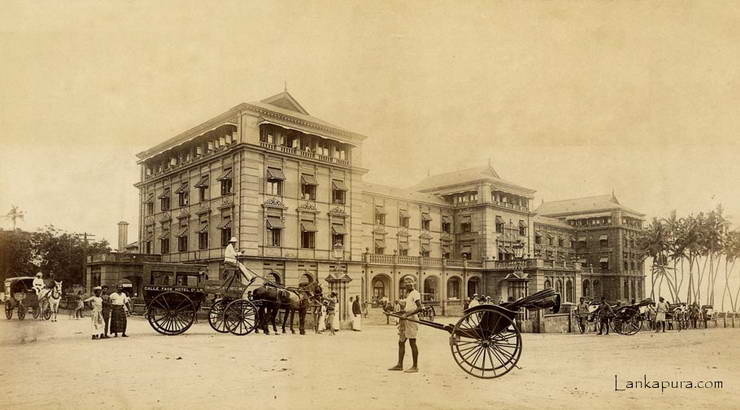
After we settled into our room at the Hilton, which overlooked the Colombo Fort and a beautiful stretch of the citys coastline, we ate a sublime lunch of Kothu Rotti, then took a much needed nap. We planned on spending our first sunset in Sri Lanka at the legendary Galle Face Hotel just a few minutes away. This hotel claims to be the oldest hotel east of the Suez, which strikes me as a rather difficult claim to verify. It is, however, indubitably a place of great beauty, and as its been open since 1864, its an institution renowned all over the world. Famous guests over the years include Richard Nixon, Arthur C Clarke, Roger Moore, and other movie stars and assorted royalty from across the planet. The buildings are stately and the grounds are meticulously manicured. While I wanted to have high tea, Becky was more interested in visiting the hotels famous bar called the Veranda, which is perched along the water and offers a magnificent view of the sunset. We sat by the water and had a few drinks (Elephant Ginger Beer is quite delicious), ate some tasty batter-fried prawns, and watched a glorious sunset unfold over the course of an hour. The colors of the sky shifted, the clouds took on gorgeous hues, and the reflections on the water took our breath away. Sunsets are a serious business here in Sri Lanka, and the highly populated west coast offers up some of the best places on earth to watch the sun descending into the distant waters of the west. We spent our first evening in Sri Lanka enchanted and slightly tipsy, and just as the sun disappeared, it began to rain. We gathered our things, paid our bill, and slipped away, with gratitude in our hearts for the opportunity to visit this astonishingly beautiful country.


Rubbing Elbows with Heads of State

Becky and I caught a 6 am flight from Bangkok to Colombo, which arrived in Sri Lanka around 9 am local time. We made it through immigration in a matter of minutes and were soon in a car headed to the Hilton Colombo, for a one night stay which I booked using Hilton Honors points. When you take an epic vacation that includes visits to multiple countries, you have to find ways to make it affordable, and for us that entailed cashing in multiple awards points in various hotels to lower our costs. Our night at the Hilton Colombo was free, and we were delighted, after an abridged night spent at a crappy transit hotel in Bangkok near Suvarnabhumi Airport, to sleep somewhere a little more upscale.

Upon our arrival to the Hilton, it was clear something very strange was going on. A phalanx of security guards and secret service types were crowded near the entrance ramp to the property, and the hotels front door was filled with men in uniform wielding machine guns. We got out of the car, and all our luggage was immediately put through a mobile x-ray machine in a truck, before we walked into the hotel to find ourselves standing on a plush red carpet surrounded by even more men in suits and shades looking anxious and skeptical at our rumpled clothing and bleary eyes. Turns out the President of Palestine, Mohammad Abbas was spending two nights at the hotel, and was about to depart for some meetings right at the moment we arrived.

We couldnt check in until he had exited the premises, so were ushered into some lobby chairs and made to wait until the man himself emerged from the elevator bank, flanked by one of the most formidable entourages Ive ever seen. They paraded past us and only after theyd left the premises were we allowed up to our room. The whole spectacle was amusing. Its been awhile since weve dealt with a security apparatus of that scale and seriousness. Getting on a plane in Thailand is not like getting on a plane in the USA, and even though Bangkok is sometimes subjected to random terrorist acts, the Thai people are among the least paranoid and most laid back of anyone youll find anywhere in the world. Sitting twenty feet away from the President of Palestine, we were scrutinized more in five minutes than I feel like weve been in 8 months in Thailand

This brief little interlude was the second time in a matter of days that we encountered a major political figure. On our first day in Angkor Wat, our tour guide pointed out an article in the local newspaper announcing the imminent arrival of 25,000 Red Shirts, along with former Thai Prime Minister Thaksin Shinawatra and his sister, the current Thai Prime Minister, Yingluck Shinawatra. We hadnt anticipated spending a holiday in the midst of a Thai political rally. The Red Shirts showed up in droves that afternoon, in countless huge tour buses and private vehicles, having driven across the border just a few hours to the west of Siem Reap. They camped out en masse at a particular site, and by the end of our first night in the area, they were everywhere. Red shirts, red flags, and banners with Thaksins face printed all over them. Thaksin is currently banned from visiting Thailand, after a 2008 indictment by a Thai court on corruption charges, but apparently hes on great terms with the Prime Minister of Cambodia, to the point where his political rallies are welcomed by the government of Cambodia. By the time we left Siem Reap, the Red Shirts were everywhere. Becky and I are entirely apolitical in Thailand, as its not our place as guests in a country to have or express any opinions on the internal politics of our host nation. Red shirts, yellow shirts, black shirts, farang, we try our best to love everyone who crosses our path. However, its hard to think charitable thoughts about 25,000 people dressed identically suddenly overrunning the idyllic temple you were hoping to have to yourself. Lucky for us, we headed out to Phnom Penh before the worst of it, and left the political rallies behind us. The rest of our vacation promises to be fairly quiet, in the isolated mountains of Sri Lankas cultural triangle, and later on the beach. Ahhh The ideal vacation spot in someplace where no human politics can find me, off the beaten path, where I have no bars on my phone nor Wifi on my laptop, and where I cant respond to work e-mails. Sadly, no such place is on our itinerary. The work never ends, even in paradise. Thats OK. Work paid for this trip to paradise, and we are eternally thankful for everyone and everything our jobs have brought to us.

Sunday, April 15, 2012

Brother Number One: the Lessons of Pol Pot


The Killing Fields were hard to walk through. The graves are just grassy indentations in the ground, and without the audio tour and the signs, you'd never know what went down here. On the outskirts of town, far from prying eyes, thousands of innocent people were brought here to be bludgeoned to death. Bullets were expensive, so throats were slit, skulls were smashed with hammers, iron rods, and rusty garden tools, and children were held by their little legs and swung headfirst into trees trunks until their brain matter was scattered across the ground. There's a pall that hangs over this place, as there should be. 2 to 3 million people died under the Khmer Rouge's fanatical 4 year reign of terror in Cambodia, from 1975-1979. Many of the people responsible escaped repercussions for their actions. There were many guilty parties involved in this holocaust, from the top on down, but much of the responsibility lies with the Khmer Rouge's self-proclaimed "Brother Number One," the Prime Minister of Democratic Kampuchea and the architect of the regime's crimes. Pol Pot was a psychopath, and he was at the helm of one of the most brutal revolutions in human history.

Pol Pot casts a deep shadow over Cambodia. Even though he died in exile in China in 1998, his presence is still felt everywhere, and his impact on the lives of all Khmer people is ongoing. In the four days we spent in Cambodia, I don't think I met a single person older than 40, which is a testament to how effective the Khmer Rouge were from 1975-79 in committing one of the worst genocides in history. They killed 25-30% of their country's population in one of the most fanatical attempts at a socialist revolution ever engineered. Upon taking power they proclaimed it "Year Zero", closed the borders of the country, and instituted a radical program intended to create a completely independent and isolated state. They forcibly emptied out Cambodia's cities, confiscated all private property, and executed anyone involved in "free-market activities." They closed schools, abolished currency, forbid communication between family members, and created vast collectivized farms in which they forced the entire population to undertake a massive, completely unrealistic goal to triple Cambodia's rice production. They starved the population, tortured and murdered at will, and destroyed all the institutions of Cambodian culture in an insane attempt to create a classless agrarian communist society. People will be studying the Khmer Rouge for centuries, as one of the most depraved and unconscionable political movements to ever take root in any country on the planet. Pol Pot was forced from power in 1979 after the Vietnamese invaded after a series of provocations, and he and his Khmer leadership fled westward into Thailand. It was 1980 before the world fully began to understand the scope of the Khmer Rouge's crimes, and yet eighteen years later, Pol Pot hadn't faced serious consequences or sanctions for his actions. He died in China in 1998, just as UN trials were getting underway into the Khmer Rouge's crimes against humanity. Pol Pot's legacy is a nation with a traumatized population, no credible economy, severely damaged institutions, and with no foundations for a civil society and no capacity to move forward from this horrific chapter of history. Former Khmer Rouge officials are still in positions of power throughout Cambodia.  There is no resolution in sight, and no means to fix the many problems that plague this war torn nation...

Cambodia's recent history is a glimpse at the worst crimes humanity is capable of. I learned a lot in three days here. It's like peering into the depths of mankind's evils, and realizing that there is no bottom. Where you thought there was a limit is just an infinite abyss. When the bottom falls out of your world, you're forced to build your convictions all over again. I suppose that's one of the reasons why we travel, to be confronted with experiences that forcibly expand our awareness. I've realized here in Cambodia that I have no idea what pain is. Everything I've ever suffered in my life is laughable compared to what these proud people have endured. My life is cake. Pure, unadulterated privilege born from good parenting, a fine genetic heritage, a strong work ethic, and the best education money can buy. Every obstacle I've ever faced has been something I could overcome with hard work or coherent thinking. I've never been irrevocably screwed by the universe. Such a stark realization puts everything in a different perspective, and I am thankful to this country and its people for reminding me of what I should not take for granted. As my mother was fond of reminding me throughout my younger years in Bangladesh, "there but for the grace of God am I..."    I hope Cambodia's warm, generous, and traumatized people can find equilibrium once again, and that they can start to rebuild all the values, ethics, and institutions that make human society livable. They deserve all the opportunities that the rest of us have been given so easily...


My Country Tis Of Thee...

A brief survey of the last four decades of Cambodian history is hard to stomach. The country won its independence in 1953, and enjoyed the briefest decade of prosperity and growth before getting sucked into the maelstrom of the Vietnam War, and four decades later, it still hasn’t emerged from the long shadow cast by that bitter and ruinous conflict. Walking through the Killing Fields amidst mass graves and piles of bones, and hearing the first hand accounts of the horrors of the Khmer Rouge leave you overwhelmed with grief and outrage of the capacity of human beings to have a willful disregard for the worth and value of human life. The recent history of Cambodia offers up a vivid portrait of how imperialism, violence, and dogma destroyed a country and its people. For anyone foolish enough to believe in the myth of a benign superpower, or the concept of a “just war”, they need to read the history of this proud and broken land. I am speaking, of course, of the United States, my own country, and the people who claim it is infallible.

I have recently been called anti-American. It’s a ridiculous accusation that’s come up repeatedly in my adult life, as I’ve spent much of the last decade publicly criticizing the foreign policy of my country, which I’ve believed to be wrongheaded, wasteful, and fundamentally detrimental to the wider health of the global community of nations. That does not make me anti-American. It makes me a student of history, and an American who is concerned, well-informed, and who believes that outspoken and critical dissent is the mark of good citizenship. Such a distinction is usually lost on self-professed patriots who feel that I badmouth the honor of their country, which is beyond reproach. But sadly, no one is above reproach, least of all governments, who are responsible for some of the most heinous crimes imaginable.

The US Government is criminally complicit in the destruction of Cambodia over the last four decades. It started when President Nixon approved the widespread carpet bombing of Cambodia in 1969, resulting in the death of 250,000 Cambodian citizens. This bombing was initially kept secret from the American public, and was not approved by Congress, who ultimately stopped this practice in 1973 when the extent of it was revealed to them. However, in the four years in which it happened, more American bombs had been dropped on the population of Cambodia than all the bombs that had been dropped by all sides during World War II. The reasons for this incessant bombing campaign against a country our government never bothered declaring war against were tied up in the US rationale for the Vietnam War. Apparently it all made good sense to somebody.

In the 1970’s the US supported a coup in Cambodia that triggered a brutal civil war, that lasted for over two decades. The actions of the players in that war cannot be laid at my country’s doorstep, but my government played all sides, armed and equipped multiple factions, and ultimately gave diplomatic recognition to a Khmer Rouge government that was guilty of crimes against humanity. The US embargo on the country triggered a deep famine that claimed the lives of countless Cambodians. Again, all of this is tied up in my government’s questionable rationale behind their choice to wage the Vietnam War.

The list of outrageous US actions in Cambodia is too long to list and document in a single blog spot. It is a chronicle of horrifying depth and stupidity, and the fact that it remains relatively unknown to most Americans is a testament to the obscurity of this country. The Cambodian people are among the poorest on the planet. They did not declare war against the USA, but had the unfortunate distinction of being next door to a country that the US decided to wage war against. Believing that a largely rural, agrarian society of poor farmers is a threat to the national security of the United States is willful paranoia, and is completely unrealistic. It is not un-American to point this out. It is human. When you walk through these killing fields, stare at these mass graves, stare at the children who’ve had their limbs blown off by landmines, and think about the causes of all this, a lot of it has to do with an inability of powerful nations to leave other nations alone. Pol Pot was not created in a vacuum, and he only came to power because of a series of actions that my country helped initiate. I hope and pray we’ve learned the lessons of Vietnam.

I leave you with these thoughts from Mark Twain, who expressed similar sentiments about America's involvement in foreign countries multiple times over the course of his life, throughout which which he was staunchly anti-imperialist. A vocal critic of the US government, this iconic American writer spent much of his life dodging claims that he was 'anti-American.' To which he responded:
"Loyalty to the country always. Loyalty to the government when it deserves it."
And again:
"My kind of loyalty was loyalty to one's country, not to its institutions or its officeholders. The country is the real thing, the substantial thing, the eternal thing; it is the thing to watch over, and care for, and be loyal to; institutions are extraneous, they are its mere clothing, and clothing can wear out, become ragged, cease to be comfortable, cease to protect the body from winter, disease, and death."

Elizabeth Gilbert on Cambodia


If you're a regular reader of this blog you know that Fuad & I have just spent the past 3 days in Cambodia. While traveling abroad for the first time as an expat, I've had some realizations, but I'd like to preface this post by saying...
I don't claim to be a writer (I'll leave that to my husband). I'm just a lady who wants to share her experiences with family & friends and whoever else stumbles upon these Chronicles...I also want to document this process for myself. Next week it'll be 9 months that we've been living in Thailand and when I look back at what I wrote before leaving & upon arrival, I can see my growth...I can also see my frustrations & longings...I've also shared quite a few realizations...

Our visit to Cambodia reminded me of a passage I read about a year ago from Elizabeth Gilbert's book "Committed." This is what she has to say about Cambodia...
"And my trip to Cambodia was...How shall I put this?
Cambodia is not a day at the beach. Cambodia is not even a day at the beach if you happen to be spending a day at an actual beach there. Cambodia is hard. Everything about the place felt hard to me. The landscape is hard, beaten down to within an inch of its life. The history is hard, with genocide lingering in recent memory. The faces of the children are hard. The dogs are hard. The poverty was harder than anything I'd ever seen before. It was like the poverty of rural India, but without the verve of India. It was like the poverty of urban Brazil, but without the flash of Brazil. The was just poverty of the dusty and exhausted variety..."
She goes on to say this about her guide around Angkor Wat...
"I was keenly aware of the fact that I was in the presence of a person who had grown up during one of the most brutal spasms of violence the world has ever witnessed. No Cambodian family was left unaffected by the genocide of the 1970's. Anyone who was not tortured or executed in Cambodia during the Pol Pot years merely starved and suffered. You can safely assume, then, that any Cambodian who is forty years old today lived through an absolute inferno of a childhood. Knowing all this, I found it difficult to generate casual conversation..."
She goes on to describe an experience she had with the children begging...and if you've ever had the deeply saddening experience of a child asking you for money or to buy something so they can eat or go to school...I don't wish that on anyone. It's so hard to say no, yet I do every time. There simply isn't enough to give to every child who needs it, and there's no guarantee to what the money will actually be spent on. This time, the hardest one was a young boy of about 10 who reached his hand through the fence that surrounded the killing fields we visited...It broke my heart to walk by him...
I agree with Elizabeth Gilbert that Cambodia is a deeply scarred and sad place. Honestly, I had forgotten I had read this about Cambodia until I was there...this is a place that has left its mark on me...

Driving from Siem Reap to Phnom Penh


We booked our return flight to Thailand on AirAsia from Phnom Penh, because it was 400 bucks cheaper than flying directly back to Bangkok from Siem Reap. This wrinkle in our travel plans meant that we had to find some way to get from Angkor to Cambodia's capital city, several hundred kilometers to the southeast. Some intrepid travelers go by boat, and others by bus, but we wanted to see a few sights around Phnom Penh and so we splurged on a private car to transport us early Sunday morning halfway across the country. Considering what's left on our two week itinerary, this seemed like a good idea. If we burn out early on some of these smaller travel legs, we won't have the opportunity to really appreciate Sri Lanka next week...

So we negotiated a price for the 5 hour drive with Mr. Hour Lyath (aka Mr.Lee), the charming young father of a newborn son who had spent the weekend driving us around the Angkor temples. He was delighted to make some extra money during the weekend of the Khmer New Year, and arranged to pick us up promptly at 7 am and drive us to Phnom Penh while also taking us on a detour to the Killing Fields at Choeung Ek. It promised to be a long day...

We packed our stuff in Mr. Lee's Toyota Camry and wheeled out of town. For the first 20 miles out of Siem Reap, the roads was smooth, a thanks to the Japanese government who helped build that stretch of the highway with grants and construction expertise. After those 20 miles, the rest of the road was built by
the Cambodian government, and there was a marked difference in the quality of the surface. When your government is incapable of producing quality infrastructure, something is fundamentally wrong...

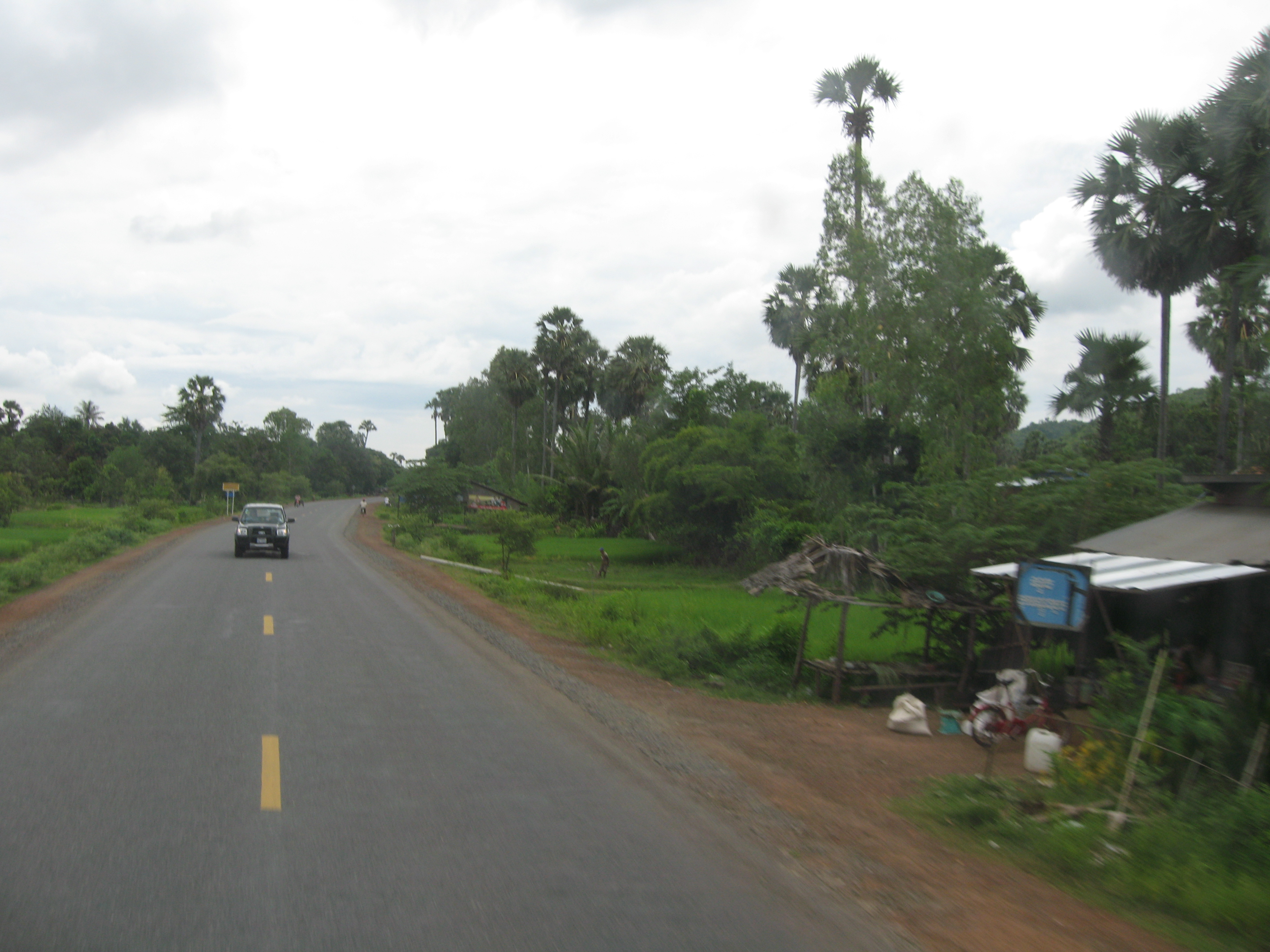
The ride was eye-opening. You'd think the road between two of the largest cities in the country would be a highway, but the entire 300 km length of it was just two lanes. National Route #6 is just a scrawny road with the occasional yellow line in the middle that no one bothered to pay attention to. No road rules applied, and the entire drive seemed like one extended game of chicken between us and cars and motorcycles hurtling along at us from the opposite direction. At the last possible moment, Mr. Lee would swerve out of the way, but I spent much of the ride wondering if entrusting our lives to Cambodian road rules was a good idea... No lanes, no speed limits, no cops... I tried not to look after awhile and just focused on the landscape passing by....

The country was beautiful. Green horizons, palm trees, and all along the road were tiny ramshackle houses constructed on stilts, with hammocks and motorcycles parked in the shade beneath each home. There was farmland as far as the eye could see, and trees of every shape and size. I've always been of the persuasion that you can't really appreciate what America is until you drive through it, from coast to coast, watching the earth's topography change as you pass from state to state. Cambodia's landscape changed as well as we drove through it, but certain aspects were consistent. There was no concealing the poverty of this country, nor its dysfunction. For all its rich biodiversity and stunning temples, the fact that vast swaths of the
country seem so underdeveloped is an indictment of the nation's leadership. The traumas of rece
nt history still loom over the horizon, and you can see it in every face you encounter. This is a country still struggling to be born anew...

Saturday, April 14, 2012

The Ruins of Ancient Civilizations


"Who controls the past controls the future. Who controls the present controls the past." George Orwell

There's so much here in Angkor to contemplate beyond the stunning beauty of the temple ruins. You could spend a lifetime photographing the temples, exploring them, and digging into the rich history surrounding each of these monuments. This entire area feels like it's caught ina time warp, as the past looms over the present and casts a deep shadow overall who live here and anyone lucky enough to wander through these grounds, enthralled with the leavings of a lost civilization. Becky and I leave here deeply grateful for the opportunity to visit this sacred place. It's going totake a long time to process what we've seen here.

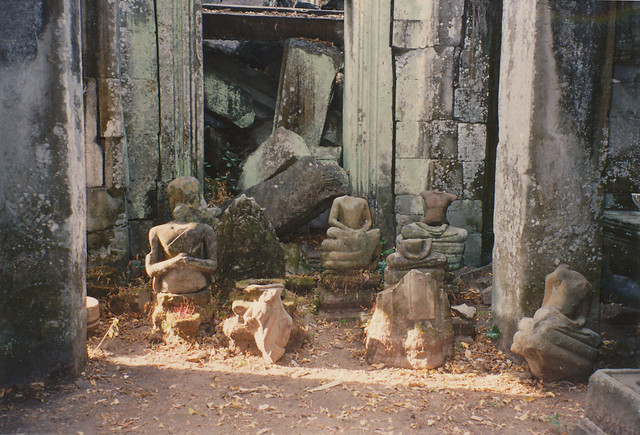
As we walked through these stones, and climbed over the rubble, I found myself thinking about time and power, and the desire of ambitious men to leave a legacy behind them, or to even alter the legacy of their predecessors. Reading through our guidebooks, I discovered that one of the reasons so many of these temples are in disarray is because later kings defaced and destroyed some of the temples created by earlier kings. The religion of the Angkor Empire switched back and forth between Hinduism and Buddhism several times, and with each shift, the iconography of past eras was rendered obsolete, so temples were vandalized, stone frescoes were altered with hasty chisels, and huge stone Buddha statues and Vishnu carvings were beheaded by zealous fanatics trying to reaffirm the primacy of their own Gods. I couldn’t believe it. In my mind, the only kind of people who destroy Buddha statues are people like the Taliban, or dogmatic dictators like Joseph Stalin, who tried to purge Soviet Russia of it’s religiosity by destroying ancient churches in the name of thestate. The idea that this happened every few decades or centuries in Angkor was hard to wrap my head around. “Who beheads a Buddha statue?” I asked Becky, after eying a viciously defaced sandstone Buddha… “It’s not their God,” Becky pointed out. “It’s to show that they’ve conquered…”

I’ve rarely seen a more vivid illustration of warring faiths and their consequences than the ruins at Angkor. The uncomfortable overlap of faiths and ideologies contributed to the ultimate demise of the greatest empire Southeast Asia ever saw. I had always assumed that Buddhism and Hinduism lived alongside each other in relative peace, which must be based on my incomplete understanding of how both evolved concurrently in ancient India. I never imagined this kind of intolerance and violence between two faiths that share a common heritage. I suppose I should know better, given the conflicts between the Abrahamic traditions over the millennia… I suppose men have always thought that part of the power of a God is his ability to demean the Gods of others. That calls to mind a famous quote: “you know you’ve made God in your image when he hates all the same people you do.”

These temples are ruins because they were not protected. Subsequent generations considered them to be an affront to their beliefs. They were pillaged by tomb raiders, raided by locals for their wood, ransacked by invading nations, and as the Angkor civilization failed, their monuments succumbed to nature and these sacred spaces eventually became part of the jungle once again. There’s a profound metaphor in there somewhere about the illusory nature of power. It’s worth remembering… Everything ultimately crumbles back to the earth from whence it came…

Bayon Temple in Angkor Thom


After spending the better part of the morning at Ta Prohm, we headed for Angkor Thom, the 10 square km walled city that houses some of the greatest monuments in Cambodia. The city was built by the Angkor Devaraja Jayavarman VII, regarded by historians as the greatest of the "God-Kings" who ruled over the ancient Angkor Empire. He built Ankor Thom around 1200 AD, and filled it with temples, monuments, terraces, and pools. The size of this city is mind-blowing, when you consider that this was constructed prior to the use of machines. Moving this much stone must have required a labor force of millions, including elephants, and the fact that it was all quarried from many miles away and floated down rivers on bamboo rafts makes the whole enterprise even more unlikely. These buildings are the work of men convinced of their own divinity.
Nowhere is this strange narcissism clearer than at the Temple of Bayon, which is the epicenter of Angkor Thom. Bayon is comprised of 54 towers, each of which is crowned by 4 faces, that look down down upon all visitors from various stages of decay. A total of 216 faces gaze out in all directions, each meant to represent various attributes of the Boddhisatva Avalokiteshvara. The temple as a whole is a Buddhist shrine, but it was altered in the years after Jayavarman VII to be a Hindu structure. More on that later. Suffice to say, Bayon is an incredible structure, which looks like huge ruinous pile of old stones from afar, but which slowly reveals hidden dimensions as you enter it and climb its stairs. The place is weird and beautiful and eerie and awesome, all at once. For more about it, check out this link.


Banteay Samre


Our driver suggested we stop at this spot on the way back from Banteay Srei, and we emerged from the car rather unenthusiastically because it was around noon and the sun was just starting to beat down in full force. We found ourselves completely enchanted with this temple, largely because it was quiet and serene and for much of the time we spent there, we were the only ones present. This was built by Suryavarman II around 1140 (the same time as the construction of Angkor Wat), and we had a lot of fun climbing around the place taking yoga pictures. Gorgeous layout, and it's fairly well preserved.

Banteay Srei "Lady Temple"


After spending the early morning wandering through the quiet halls of Angkor Wat, we headed out of the main city to see some of the other cultural artifacts in the area. The pink stone temple of Banreay Srei is 30+ kilometers out of the city, and it's distinctly different from the Angkor temples. It was built by a Brahman, possibly a tutor to the royal lineage, and while scholars debate the date of this, there are historical markings indicating that it was created in 967 AD. It's waaaay ahead of its time, and what's astonishing about this particular temple is the incredibly detailed and intricate stone carvings that adorn the walls and inner areas. This is a small temple, compared to the Angkor monuments, but it's achingly beautiful, and it's referred to around the area as "The lady Temple," because it's believed the intricate stone carvings are the work of women artisans. This Hindu temple was devoted to Shiva. Below are some pictures.

Angkor Wat


I can't find a way to succinctly describe Angkor Wat. We spent the late afternoon of our first day there, under a merciless sun, and then we came back at dawn the next day to see it in all its glory at sunrise. No amount of flowery descriptions could do justice to this temple. It's a mystery and a marvel and something everyone should put on their bucket list. I'm glad to have crossed it off of mine, but I do believe we'll have to return, to delve deeper into this building, and perhaps to try once again to photograph it. On the first day we visited, I found it hugely frustrating to try and take pictures, because the scale of this is lost in pictures, and on my rinky-dink little camera I couldn't find an angle that really felt right. This place is impossible to wrap your head around, on multiple levels.
Constructed around 1152 by the Angkor Devaraja Suryavarman II, this "mother of all temples" was built to honor the Hindu God Vishnu. There are countless unique characteristics of it, and there are details and halls worth exploring that make the place well worth repeated visits. As the world's largest religious structure, it's astonishing that this was constructed in the era in which it was, without machinery to ease the burden on the workers who built it. It took 37 years... It's in better shape than the other Angkor temples...but it stills bears a lot of the marks of the turbulent history of the Angkor empire. Have a look at some of the pictures we took below. They're just a glimpse of what we saw, and this building is an infinitely deep mystery well worth probing...

Ta Prohm - Angkor's "Jungle Temple"

We spent some time plotting out a two day itinerary for our brief stay in Siem Reap. There's no shortage of temples to visit, so we had to parcel out our time and prioritize what we wanted to see. Over the years, there's been a couple of circuits that travelers have developed, to be efficient with their time and visit the temples in an order that makes sense. While those plans looked OK on paper, they didn't really match up with our schedule. We needed to plan our visit to try avoid the huge crowds of people who descended upon Angkor for Khmer New Year, and also to deal with the unbearable heat of the midday sun. Plus, there are some inherent limitations on how much you can really take in on any given day. So we settled on a plan that entailed visiting Ta Prohm, Ankor Tom, and Angor Wat on our first day. On our second day, we'd visit Angkor Wat at dawn, then head out to see Banteay Srei, Banteay Samre, and whatever else we could fit in. While that doesn't sound like a lot on paper, each of those visits entails climbing countless stairs and trekking from one place to the next on foot, which gets tiring really fast when the heat index is past 40 degrees celcius (over 100 degrees fahrenheit). These are some of the world's largest monuments, and seeing them is no small task...

We started the day off at Ta Prohm. This is the famed "jungle temple" of Ankor that was made famous by its use in the movie Lara Croft: Tomb Raider. Angelina Jolie filmed a few scenes here, and as a result, the temple was overrun with tourists taking pictures next to "the tomb raider tree." Although we tried to beat the crowds, there's no avoiding the crush of tourists in Angkor, and while our visit to Ta Prohm was awe inspiring, it was also infuriating. Becky and I both find oblivious, self-involved tourists to be hugely annoying, and Ta Prohm was filled with people stepping on our feet, inadvertently getting in other people's pictures, and trampling through the space with little regard for anyone else around them. It was irritating, but not enough to obscure the magic and mystery of the temple in question. The place is simply stunning.

What make Ta Prohm particularly poignant is the way the jungle has completely overrun the monuments. Giant trees have wrapped their huge root systems around the enormous eroded stones, and where there was once symmetry and order to this temple, there is now a sense that the ambitions of the men who built this have been entirely eclipsed by the laws of nature. This is the jungle's turf, not man's. Originally constructed in 1186 as a buddhist temple, this brooding ruin of a structure is in a unique state of decay. The stones are covered with lichens and the walls are wrapped with creeping vines, and huge trees have grown up in and around the structures, using the stones as building blocks for enormous root systems. Multiple nations are helping to restore parts of this temple, and outside of its main wall there are hundreds of the original structure's huge stones that have been marked for placement in various spots throughout the temple. It is, as our guide put it, "the world's biggest jigsaw puzzle." It's hard to really imagine what this temple could possible look like once it's been restored, since so much of it seems beyond fixing. Trying to describe in words the incredible look and feel of Ta Prohm is an exercise in futility. It's like something out of a fantasy novel... Have a look at a handful of the pictures we took. Everywhere you look there's something camera-worthy, so we spent most of our morning dodging fellow tourists, rolling our eyes at some of the more obnoxious travelers amongst us, and shaking our heads and marveling at the magic of this enchanted place. Some ruins feel tragic, because there's a humanity to their decline that you can't help but feel attached to. Ta Prohm was not like that for us. Life never stopped here. When the humans abandoned it, the trees moved in...

Thursday, April 12, 2012

Khmer Massage Versus Thai Massage


We arrived in Siem Reap at 8 pm after a really quick flight from Bangkok. While the flight was pleasant and the service was fine, it's still an absolute racket that Bangkok Airways has a monopoly on the BKK-REP route. We used air miles to get to Angkor for free, so I really shouldn't complain, but the actual cost of a flight from Bangkok to Siem Reap is totally disproportionate to the length and distance of the journey. It's less than an hour away by air, but truly, once you cross the border, it's a totally diff
erent world...

We got our first taste of Siem Reap upon exiting the airplane, walking down a set of stairs, and then going on foot from the plane to the international passenger terminal. There's not a lot of airports in the world where you walk across tarmac upon first setting foot in the country. The last time I did that was either in Nepal or Bangladesh in the early 90's. The airport was surrounded by utter blackness, with no lights or city in sight, and there were only two other planes in the distance. The place was pretty desolate. Immigration was a breeze and no one was even manning the customs inspection area. All my worries about getting in proved to be unnecessary anxiety......by the time we settled into our hotel room, at the beautiful Borei Angkor Spa & Resort, it was after9 pm. We called and set up a one hour massage because it was affordable and we figured we'd get a quick rub in after traipsing around Bangkok in 100 degree heat with all our luggage. We'll be spending the next two days meandering through extensive temple complexes, so it doesn't hurt to get your feet rubbed before you put them to work. The massage was marvelous and it left us thinking about the differences between Khmer massage and the Thai massage we're more familiar with.

Firstly, it would be irresponsible to offer up a critique on Khmer massage based on a single one hour rub at a resort. That's an insufficient sample size to really make any kind of valid judgment, but we'll offer up some impressions here anyway because they're fresh and we get rubbed a lot. We're massage junkies of sorts, and living in Chiang Mai has made us acutely aware of the differences between a good rub and a lousy one. Not that we ever complain. If you're paying the equivalent of $5 US dollars for an hour long massage, you're in no position to whine about a masseuse who takes a call on her cell phone while she's rubbing you, or one who starts singing along to the horrible music on the radio, or one who spends the entire hour giggling and gossiping with her friends in the room. You take what you're given and appreciate the fact that someone just spent an hour trying to make you feel better in your body. Sometimes, though, a half-assed massage can leave you worse off than when you started...

Thai massage usually follows a certain format, and while that's a big sweeping generalization, we've been rubbed enough to be able to describe the fairly predictable formula most Thai masseuses employ. It's one thing to go to a master, or to go see someone who is willing to scan and delve into your body's quirks and address your individual needs, but most of the time, when you pay for a cheap massage, people just go through a set formula they've learned. They'll start with the feet, and slowly and meticulously work their way up, pressing and squeezing along the meridians, the body's energy lines as documented and described in Chinese medicine. In Thai massage these are called "sen", and they constitute a body map that overlaps pretty concisely with what we in yoga call the nadi system. These lines are also what acupuncturists use when they place needles on the body. These energy lines are documented differently by various traditions, but each of these healing modalities use them as a reference for figuring out where to squeeze, stroke, or trigger. In any case, in Thai massage, the masseuses slowly work up the sen lines, and they tend to spend an inordinate amount of time focused on the legs. Becky and I have often discussed that it's quite different in the US, where masseuses focus more on the shoulders and back, because that's where Americans tend to hold their stress. in Thai massage, they'll prod and press deeply into your hamstrings and groin, while you're lying face-up on a mat, and then they'll eventually ask you to turn over, at which point they'll start working on your upper torso. There's a rhythm and pace to all this that feels marvelous when it's done well. The kneading and pulling will eventually progress into some deep stretches after your body has been warmed up. In these assisted stretches, the masseuse will utilize leverage and body weight to twist and contort you into a multitude of positions, while also cracking your spine, and possibly other joints along the way. The massage will conclude with you lying with the back of your head in their lap, while they rub your temples and face. Mind you, this is not what happens with sacred bodywork when someone is seriously committed to exploring your body and helping you release stress and anxiety. What I've just described is more or less the formula that's used when you pay someone in Thailand a pittance for a quick massage. You get what you pay for.

The hour long rub we had here at the Borei Spa and resort was quite unlike the Thai massages we've grown accustomed to in Chiang Mai. Firstly, we started off face down. The masseuses worked over our backs first, and then moved to the hips and glutes. Then we were turned over and they started with reflexology that progressed quickly up the legs. The touch was much gentler than what we're used to in Chiang Mai. In Thailand, there's an entirely different sense of where people's pain thresholds are. That's another blanket assertion, but one I think bears out upon examination. I briefly studied Muay Thai in my early 20's (that's Thai kick boxing for the uninitiated), and I can honestly say I've never encountered a martial art that requires a higher threshold of pain. Perhaps that's completely unrelated to Thai massage, but I do believe that massage in Thailand is less about delivering physical pleasure as it is about addressing the ailments of the body through a targeted sequence of techniques. Perhaps its the same here in Cambodia, but it felt quite different tonight. It was much gentler, much more soothing, and the sequence felt distinctly different from what Becky and I have gotten used to in Thailand...

It occurs to me, as I write this, that perhaps my perceptions are entirely wrong. A masseuse at a spa, doing one last rub at 10 pm before she wraps up her day, might just be trying a different approach after working a long shift. In that case, all my assertions are baseless, and my observations become the pretentious ramblings of someone who thinks they know what they are talking about. Perhaps that's true. But I don't think so. There's something different about the way they do things here in Cambodia, and they will tell you that Khmer massage is the source for what the Thais do today. That said, claims like that are made all over the world when one tradition claims that something similar to it is derivative. It's hard to tell. But the history of this area is one of conquest and cultural diffusion, and there's no doubt that some of the ancient knowledge ensconced here changed when it moved west. I guess after everything I've just written, I couldn't really tell you in great detail the difference between Thai and Khmer massage. Guess I'll just have to get rubbed again tomorrow to see if my suspicions hold up. Then, to verify or disprove my assumptions, I might have to get rubbed again the next day. I could get used to this country. ;-)

City Dwelling Part 2 Bangkok

Another great way to get to know a city? Public transportation! Day 2 of my Bangkok holiday started with a short walk (this time only 10 minutes) to the BTS (Bangkok Mass Transit System, otherwise known as the "Skytrain") This train system is very user friendly (farangs included!), and it's clean & has plenty of AC!
My plan for the day was to explore the city from the Chao Phraya River, so I took the train to the Central Pier where I picked up a tourist boat day pass for 150baht ($5.00) and with this pass I could ride up & down the river to my hearts content, getting on & off as much as I pleased. 

Here I am seen holding my transit map at the start of the day...smiling, fresh, ready for my adventure!

Deciding to get on a boat was a big decision as I suffer from motion sickness very easily, but with the size and type of boat, I was ok.

I decided to ride all the way to the last pier, then work my way back and honestly, there was interesting sights to be seen at all of them (I think there were around 10 piers in total). At the last pier, there's an area known as Khao San Road, a spot that became well known as "backpacker central" because of the inexpensive guest houses available for budget travelers. It's kind of like hippie central...I took the short walk to the thick of the area and turned right around...not for me! The streets and sidewalks are way too crowded, plus it was REALLY hot & I was hungry. I found a restaurant called "Joy Luck Club" (one of my favorite books & movies) that advertised vegetarian food. I walked in to discover a quirky family run spot & ordered one of my favorite dishes in these parts...vegetarian massaman curry, they won me over with the bear shaped rice (seen below missing his arm) it was absolutely delicious & very unusual, it was served with crisp fried onions on top.  I drank a very refreshing mango smoothie & while I enjoyed this delicious meal, Allison Krause was playing...I was the only one there, I smiled to myself and thought "I want to remember this moment," enjoying yummy, fresh food listening to sweet tunes, off  on my very own adventure...

I made my way back to the boat and got off to see Wat Arun, Temple of the Dawn. Since the piers are all on one side of the river and Wat Arun is on the other, you get off the tourist boat and board a ferry (3 baht) to cross to the other side. The temple was not crowded at all, in fact I don't think I've been to a temple here with so few people, so that was nice. I can't believe I did it, but I climbed the stairs as high as you could go all the while remembering a the famous Eleanor Roosevelt quote to do something that scares you each day...I was scared! Those stairs were STEEP! I've included a few videos I took while I was there.
This was an amazing experience...Temple of the Dawn, I loved it.


 After I took the ferry back across & got back onto my tourist boat I was exhausted, covered in sweat & at the same time elated, it started to rain & the fresh, cool water felt so refreshing. The sky looked like this...

I have a picture (not ready to share yet) of how I looked at the end of the day...after walking, taking the train, riding boats, walking some more, climbing very steep stairs, more boats, more trains & another walk...I was a hot mess!
But, after a nap, some yoga & the best Indian meal I've ever tasted...I looked like this, it's kind of dark & Fuad is hard to see, but I think you can see the joy in my eyes. Having 2 days to explore Bangkok on my own while my wonderful husband worked was priceless to me. I have a new understanding & appreciation for this city and I'm glad. My husband flies off every week to spend time here...I don't want it to be a big mystery, I want it to feel like home. 


 Next stop on this adventure...Cambodia!

Wednesday, April 11, 2012

Dinner @ Gaggan


On our last night in Bangkok, Becky and I devoured a phenomenal meal at Gaggan on Lang Suan Road. I had heard about this place about a year ago, after reading a profile of chef Gaggan Anand in a magazine article about Bangkok's most famous gourmands, and the restauranteurs pushing the city's culinary profile forwards. Gaggan was the only Indian chef listed in that article, and what jumped out at me was the fact that he'd trained with the legendary Ferran Adrià in Spain. Now, I'm not a huge fan of this new and emerging trend of "molecular gastronomy." The idea of creating food in a lab-like environment doesn't speak to my sensibilities at all, yet I keep reading that some of the best chefs in the world are doing astonishing things with this new approach. In Chicago, there's a restaurant called Moto where chef Homaro Canto is doing things like printing pictures of sushi onto edible paper, instead of actually making old fashioned rolls. Sounds crazy, but it apparently tastes magnificent. I've always eyed this new future-facing approach to food with suspicion, because I for one like my food made by hands, not machines. Aside from my biases, the cost of a meal at a place like Moto can be astronomical, so it's always seemed like something worth trying for novelty's sake, but I've always regarded molecular gastronomy as a trend only worthy of the wealthiest palettes. Not for a down-home Bengali boy like me...
Or so I thought...
Gaggan advertises itself as a home for "progressive indian cuisine." Becky and I booked a table, and found ourselves in an amazing spacious house filled with lovely decor. The staff was solicitous and warm, the wine list was intriguing, and the menu was a delight to read through and marvel at. While there were plenty of dishes on the menu that piqued our interest, we ultimately settled on some fairly standard entrees. We ordered some bhindi masala (fried okra and tomatoes), saffron rice, a cheese naan, chicken tikka masala, and a fusion pea dish that Becky thought looked enticing. Turns out the pea dish was not an option on this particular evening, as the chef (i believe it was Gaggan himself) ventured out to offer up an alternative, which turned out to be a divine pea and mushroom bhaji. We ordered fairly standard items because you can tell a lot about the worth and quality of a restaurant by the way they do everyday dishes. If an Italian restaurant can't get a spaghetti bolognese right, there's not much chance their more ambitious dishes are worth your time. That, at least, is my attitude. The article I'd read on Gaggan asked him what his signature dish was, and he responded by naming Chicken Tikka Masala. I thought that was an astonishing answer, because almost every Indian restaurant on the planet offers up a version, and there's not a lot to differentiate the dish from one place to another. We ordered it in the hopes of seeing what made Gaggan different... I was delighted to discover that everything I'd read was validated within the first few bites... This place lived up to the hype.

I can honestly say that the food that emerged from Gaggan's kitchen was the finest Indian food I've ever had. I am no dilettante when it comes to the cuisine of the subcontinent. My great great great grandfather was the Nawab of Dhaka, and my ancestors made a name for themselves by developing a cuisine so rich and decadent that they soon became caricatures of aristocracy, growing fat and happy on progressively more outlandish meals. We are known in Bengal as a rich family that ate itself out of its fortune over the course of several generations. I can attest to the fact the food is part of my heritage, and beyond the delectable marvels that I've sampled from the kitchens of my aunts, I've also traveled the world, and eaten at fantastic indian restaurants on 5 continents. I love Indian food, whether it's at a fantastic Mangalorean spot like Trishna in Mumbai, or a high-end Kashmiri curry house in London, or a 3-dollar plate of greasy biryani at Ghareeb Nawaz in Chicago's Roger's Park neighborhood. Each has its rightful place in the great spectrum of Indian food, as do street dishes like pani puris. It really amazed me to discover food at Gaggan's that I could never have imagined....

I highly recommend checking this place out. I could wax poetic about each dish we tried, trying to nail down the distinctiveness of everything, but honestly, words don't do it justice. I've had a thousand chicken tikka masalas, and yet what was served up at Gaggan was superior, yet I cannot quite describe why. Becky and I had finished the whole bowl and I was still trying to figure out what made it different. If you're in Bangkok, have an inclination for some Indian food, and want something different, check out Gaggan. Be sure you have some money to burn too, because it's not cheap. But it was worthy every penny. I'll be back soon. What a find.... No wonder Gaggan spent some of his younger years as the President of India's personal chef....

Tuesday, April 10, 2012

City Dwelling in Asia, part 1 Bangkok

Bangkok! What an amazing city! According to this list Bangkok is the 28th largest city in the world, interestingly followed by Chicago, however Bangkok seems infinitely larger than Chicago (at least to me).
We're here for a few days so Fuad can work before we head out on our vacation. We're staying at a "boutique" hotel tucked away off the bustle of the main streets in a quiet area near Lumpini Park and the US Embassy.
Lumpini Park

Yesterday after Fuad went to work I decided to walk to the Jim Thompson house, according to my iphone maps this would be a 40 minute walk. I told myself there is no better way to get to know a city than by walking the streets. I kinda wish my iphone had told me that it would be an exhausting 40 minutes due to the route not having much shade and 100 degree temperatures rising before the noon hour. Three quarters of the way there, I spotted something that gave hope to my sweat drenched body & parched mouth...a sight in the distance that made my heart flutter...The Paragon Mega Mall! Yay a Starbucks! I had to stop. HAD TO...so then I HAD TO stop at the department store where I know they sell the products I love, the products that remind me of home! Origins, Bert's Bees (which I find so interesting is sold along side Mac, Bobbi Brown, Origins, Clinique etc...and you can get this stuff at any Walgreen's in the States). While in the department store, I participated in one of my favorite past-times...stealth observation, otherwise known as "people watching". I will admit, I'm fascinated by women who live under the veil. Don't be fooled! These women are the most expert shoppers I have ever stealth-ly observed! They spend their money freely, usually with hordes of children surrounding them, which they loudly boss to go get them a different size/color/shape. They leave the stores burdened down with shopping bags...it makes me wonder...what's really under that veil?
Anyway...then I HAD TO go to the gap! There is just something about gap clothes...the fit, the feel, the look, lucky for me yesterday there was a sale!

Now to continue my journey to the Jim Thompson house, in the heat, with shopping bags & refreshed from a Starbucks Green Tea Frappe...


The cost of the Jim Thompson tour with a guide in English is 100 baht and you can stay as long as you like wandering on your own after the tour. There is also a restaurant and shop where you can buy some Jim Thompson Thai Silk Company wares.


I really enjoyed this tour and I was so glad that I took some time to research Jim Thompson before going...I loved imagining all the rich & famous who were invited to dine at this house and how difficult it must have been to do everything he did in the era in which he did it. Now he's a legend and a bit of a mystery, he disappeared in Malaysia in 1967 and to this day no one knows what happened to Jim Thompson.
When I left the house, I was talked into taking a tuk tuk back to the hotel...after refusing to give in, finally the guy was honest with me...he would only charge me 10 baht for a ride to my hotel IF I would agree to look at a shop on the way there. I only needed to look for 10 minutes and he gets a free gas card from the shop owners. Ok, I finally agreed. We shook hands on our deal, "10 baht, right?!"
I got to the shop and discovered it's one of these "custom-made-to-order" shops that makes tailored dresses & suits. I immediately wondered how I was gonna look around for 10 minutes, there's hardly any merchandise to look at but there's plenty of fabric bolts...I headed over to where some shirts for men are hanging...so, Fuad ended up with a few new items too, everybody happy. I got a 10 baht ride home, Fuad got 2 shirts, and the tuk tuk driver got his free gas card and it's only 3 o'clock...

What adventures await today...?